Past Questions and Answers – Secret to Passing International Exam 2026
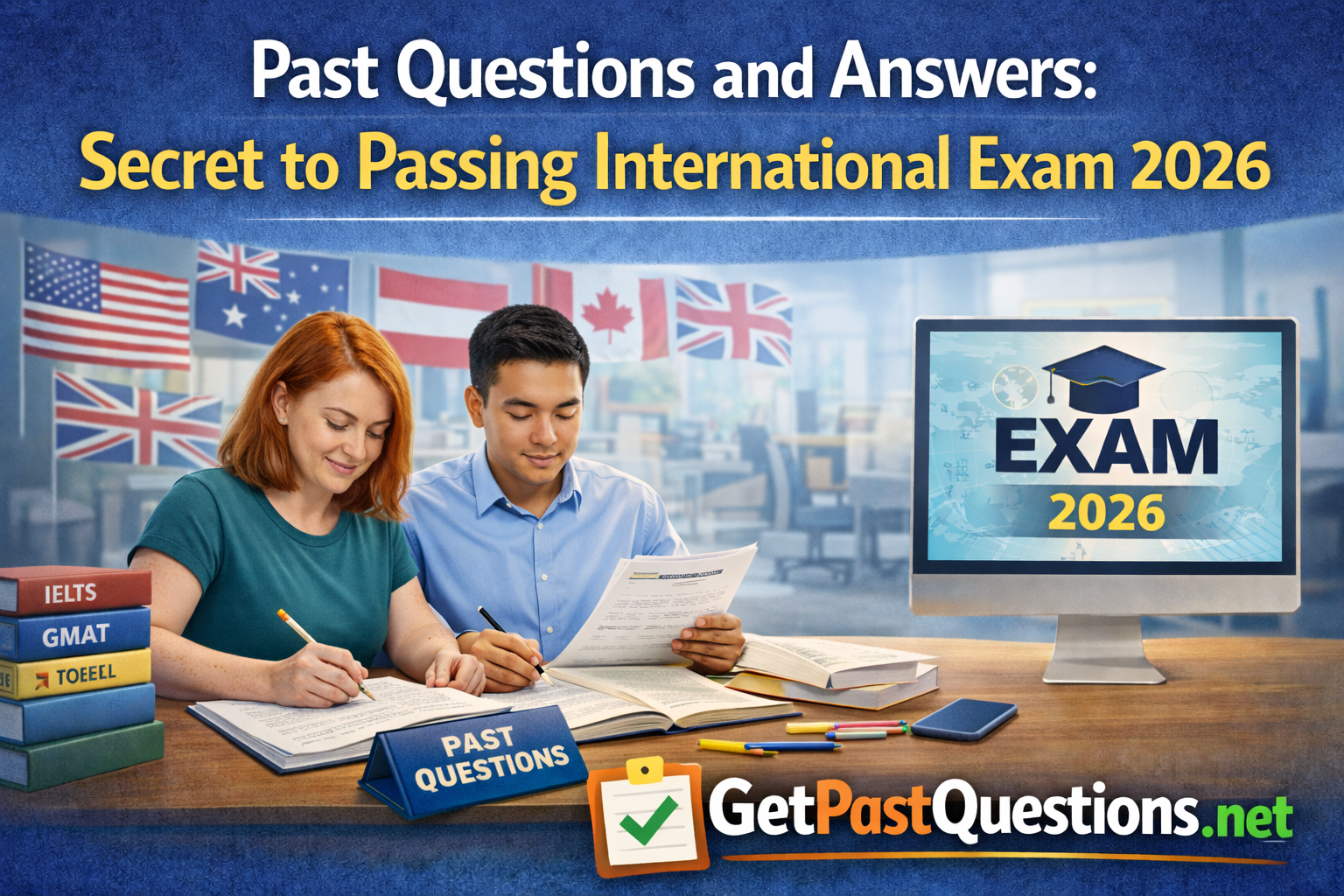
Past Questions and Answers: Secret to Passing International Exam 2026. If you’re planning to sit for an international exam in 2026 like the IELTS, TOEFL, or any of those big-letter acronyms that usually keep us up at night, then you might have probably felt that little flutter of panic in your chest.
With so much pressure and not knowing what to expect along with everyone telling you how competitive it is, it definitely feels like you would be needing a superhero to help you pull this off.
But what if I told you that the real secret isn’t about being a superhero? It’s about being a little bit of a detective.
Now the secret to passing an international exam isn’t necessarily hidden in a dusty library, it’s sitting right there in plain sight: Past Questions and Answers.
In this comprehensive guide, we talk about why this simple tool is actually your absolute best friend for passing international exams in 2026.
Why Textbooks Alone Won’t Cut It
Textbooks are great. They give you the foundation. They teach you the rules of grammar, the formulas for math, or the theories in science. But studying only a textbook is like learning how to swim by reading a manual on a sunny beach.
You know the theory, but you haven’t gotten into the water yet.
Just like your local exams, international exams have a pattern. They have tricky ways of phrasing certain questions. You won’t catch these little secrets from a textbook. You catch them by diving into the water and swimming through the actual exams.
Why You Need Past Questions and Answers
- It helps you to recognize patterns in previous exams.
- When you practice with past questions with a timer, you’re not just testing your knowledge. You’re building your exam stamina. You’re training your brain to work fast under pressure. For example, the first time you try a past paper, you might run out of time. That’s okay! That’s the point. The second time, you’ll be a little faster. By the tenth time, you’ll be faster than you imagine and you would still have enough time to check your answers and take a deep breath.
- It would help to get rid of exam anxiety.
How to Use Past Questions the Right Way
- Start early. Don’t wait until the month before the exam. Start now. Even if you haven’t finished the syllabus, just take a look at a paper. Read the questions. Get comfortable with the language they use because it takes the exam fear away early.
- About halfway through your study plan, sit down and try to attempt a full past paper without any help. No books, no phone. Just you and the clock.
- Mark yourself honestly. It might hurt a little if the score is low, but that pain is a powerful teacher because it shows you exactly where your weak spots are.
- If you have enough time to spare, when you check the answers, ask yourself, “Why did I get this wrong? (Was it a mistake? Did I not understand the concept?) Why is this the right answer? How can I make sure I get it right next time?
- Now try the papers again. You’ll be amazed at how much easier it feels the second time around.
Common Mistakes to Avoid Making While Using Past Questions
1. Reading the Answers Before Trying
This is the biggest mistake a lot of students do with past questions. Obviously it’s tempting. You look at a question, your brain feels a little tired, and you think, “Let me just peek at the answer so I know how to solve it.” But here’s the thing. Peeking at the answers is not practicing. When you look at the answer first, your brain takes a shortcut. It thinks it understands, but it hasn’t actually done the hard work of figuring it out.
2. Only Practicing the Topics You’re Good At
Sometimes when you’re going through past questions, you might naturally find yourself going toward the questions you’re good at or subjects/topics you love. But those tricky subjects/topics you keep skipping, those are exactly the ones you need to practice the most.
3. Ignoring the Timer
Although timing yourself might feel stressful, it’ll come in handy. If you notice, a lot of students solve past questions in relaxed mode and use an hour to answer a 30-minute section. But speed is a skill, just like knowledge. And skills need practice. If you never practice under pressure, your brain won’t know how to perform when the pressure is real.
4. Not Reviewing Your Mistakes
After a student finishes a past paper, calculates their score, sees it’s low, he/she gets discouraged. They toss the paper aside and move on to the next one. But look, a past paper you’ve completed is a goldmine of information! If you don’t look at why you got something wrong, you’re just going to make the same mistake again tomorrow. That’s why the answers are there as a backup for you.
5. Forgetting to Simulate the Environment
There’s a difference between doing a past paper on your bed with music playing, and doing it at a silent desk with a strict timer. Your brain associates environments with certain behaviors.
6. Giving Up Too Soon
The first past paper you try might be rough. Maybe you score 40%. It’s easy to look at that and think, “What’s the point? I’m never going to pass.” But that first score is not your final score. It’s just your starting point. Every mistake you make now is to ensure you don’t make it in the actual exam.
What to do Instead
- Treat every past paper like it’s the real exam. No peeking. Even if you’re stuck, stare at the question for five minutes. Struggle with it. That struggle is where the real learning happens. Then, after you’ve tried your best, you can look at the answers and see where you went wrong.
- Go through the past paper and highlight the questions that scare you. Do those first.
- At least twice a week, set your timer and recreate the exam feeling. Put your phone in another room. Tell yourself this is the real deal. It might feel uncomfortable at first, but you’ll get used to it over time.
- Once a week, do a mock exam. Sit at a proper table. Clear your space. Time yourself strictly. Dress like it’s exam day if that helps. This trains your brain to perform under the exact conditions you’ll face in those international exams.
Conclusion
As you plan your study schedule for that international exam, don’t just pile up textbooks. Keep past questions and answers that you would use to practice with because the exam isn’t an obstacle; it’s just a door to the next phase of your life. And with enough practice, you’ll have the right key to open it.